The Willing Bystander: Using an AED when every second counts! – Part C
Table of Contents
AEDs Are Everywhere — So Why Aren’t Survival Rates Improving?
The government and businesses have purchased thousands of AEDs, they are virtually everywhere and yet the survival rates haven’t improved. We still have <5% survival rate and yet the rare times when the public starts CPR and uses an AED the survival rates are more like 35% — that could mean the difference of 1,000’s of lives saved every year.
As we discussed in The Big Mistake blog this is part three – How AEDs Actually Work. Please watch this short video on how an AED actually works so you can become a willing bystander. 📺 Watch the video below.
How AEDs Work — And Why Timing Matters
People need to know that an Automated External Defibrillator (AED) is quite easy to use. The situation of managing someone in cardiac arrest is stressful and likely very upsetting, but the patient needs people to help them. When the heart goes into cardiac arrest and stops beating and pumping blood, the person will die within 5–10 minutes — long before the 9-1-1 Emergency Services arrive.
Over 90% of the time when a person’s heart stops, the heart goes into a rhythm called “Ventricular Fibrillation” — and the only way to stop the heart from fibrillating is to DE-fibrillate it. Hence the name Defibrillator. That is why defibrillators were invented: to reset the heart and return a normal rhythm so it can start working and pumping blood again.
What To Do If Someone Collapses — Step By Step
If you find a person unconscious — please yell for help and have someone call 9-1-1, assess the patient, determine if the patient is unconscious, not moving, does not have any signs of circulation or does not have a pulse. If so, then start CPR immediately and have someone bring you the AED. Once the AED is available, turn it on, stop CPR, and follow the voice prompts. The 4 Steps to using an AED are:
Turn on the AED and follow the voice prompts
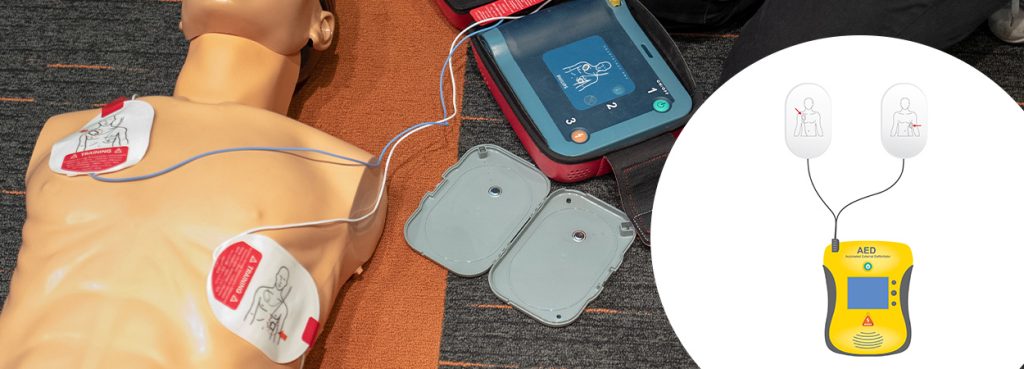
Connect the electrodes — simply peel the electrodes off the plastic and stick them on the patient’s skin as shown in the electrode package
Let the AED analyze the heart rhythm — the voice prompt will say “Do not touch the patient, analyzing the heart rhythm”
If a shock is advised — the voice prompt will say “Shock Advised – Press the Flashing Shock Button.” Tell everyone to stand clear, don’t touch the patient, and then press the flashing shock button when it is safe, so the AED can deliver the life-saving shock
If the AED says “No Shock Advised,” the AED cannot deliver a shock. Even if you push the shock button, you cannot override the device.
This is why there has never been a lawsuit in the use of AEDs in Canada. The Good Samaritan Law and the Chase McEachern Act protect the public from any legal action when they are trying to help a patient and use an AED. Please Become a willing bystander™your family, friends, coworkers and community members will all be happy did!
Share Our Blog
Author of this blog
Scott Ashley
Since 2001, Scott has helped lead his team to develop Emergency Management, Business Continuity, and pandemic planning for all levels of government, hospitals, school boards, professional services firms, and Fortune 500 companies.
Ready FIRST AIDE™ is the latest program to help the members of the public prepare and respond to a medical emergency
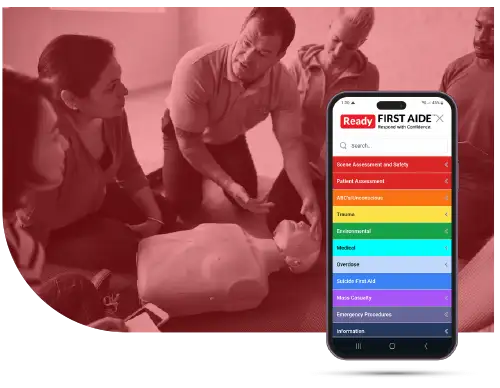
We know the problem: Bystanders hesitate because they’re afraid or can’t recall their training. Our solution is the Ready FIRST AIDE™ web application.
The app offers immediate access on your mobile device, featuring:
To provide the best experiences, we use technologies like cookies to store and/or access device information. Consenting to these technologies will allow us to process data such as browsing behaviour or unique IDs on this site. Not consenting or withdrawing consent, may adversely affect certain features and functions.
Functional
Always active
The technical storage or access is strictly necessary for the legitimate purpose of enabling the use of a specific service explicitly requested by the subscriber or user, or for the sole purpose of carrying out the transmission of a communication over an electronic communications network.
Preferences
The technical storage or access is necessary for the legitimate purpose of storing preferences that are not requested by the subscriber or user.
Statistics
The technical storage or access that is used exclusively for statistical purposes.The technical storage or access that is used exclusively for anonymous statistical purposes. Without a subpoena, voluntary compliance on the part of your Internet Service Provider, or additional records from a third party, information stored or retrieved for this purpose alone cannot usually be used to identify you.
Marketing
The technical storage or access is required to create user profiles to send advertising, or to track the user on a website or across several websites for similar marketing purposes.

 This is why there has never been a lawsuit in the use of AEDs in Canada. The Good Samaritan Law and the Chase McEachern Act protect the public from any legal action when they are trying to help a patient and use an AED. Please Become a willing bystander™ your family, friends, coworkers and community members will all be happy did!